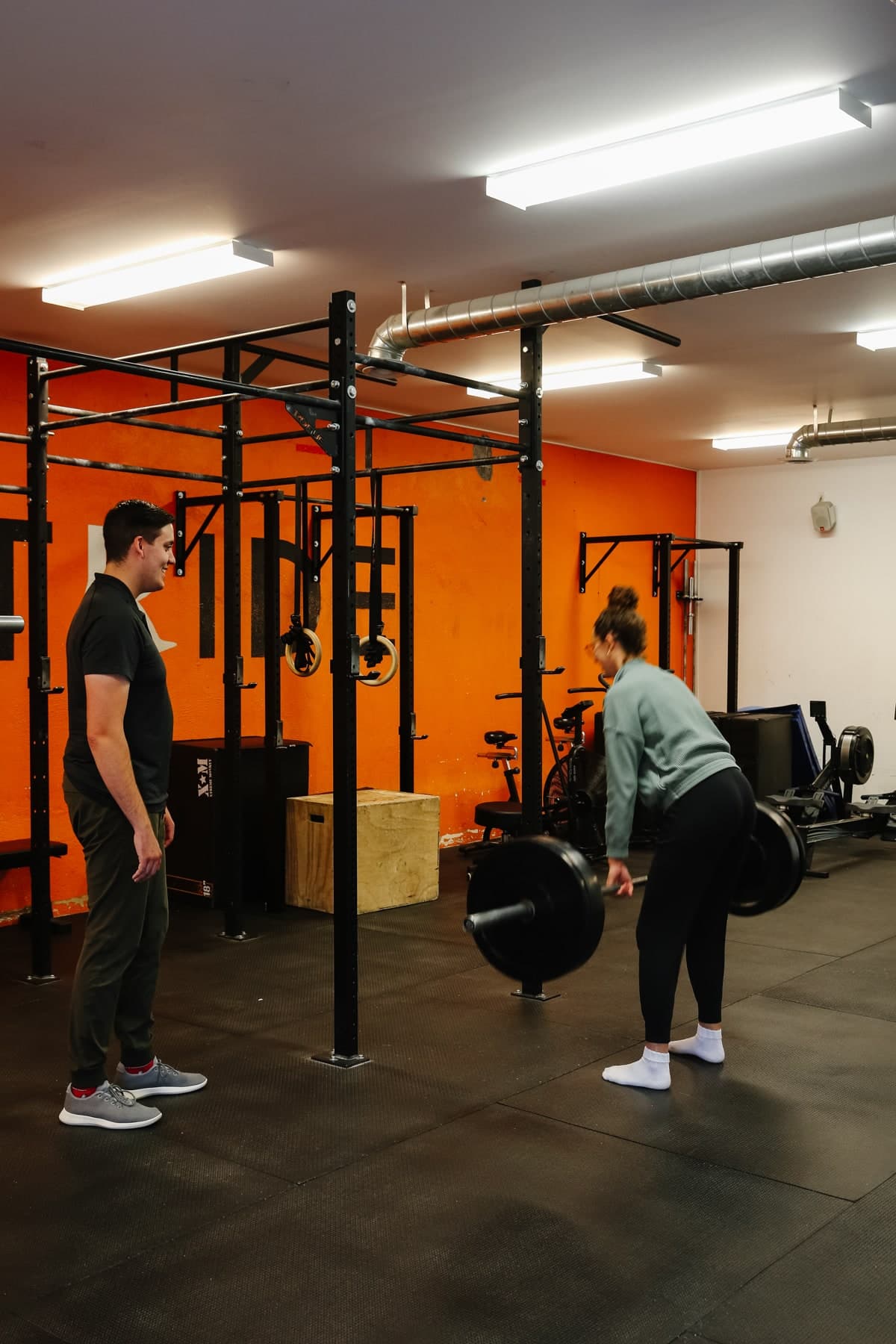
Short answer: for most people, no: research hasn't found that one "correct" lifting posture prevents back pain. If you're getting started, being active regularly matters a lot more than moving perfectly.
Here's something I hear in the clinic all the time: "I'd like to start working out, but I'm worried I'll do it wrong."
That worry usually comes from good places. A coach, a gym poster, a well-meaning family member. Keep your back straight. Don't let your knees go past your toes. Never bend over to pick something up.
The trouble is, when you stack up enough rules, moving starts to feel risky. And for a lot of people, the easiest way to avoid doing it wrong is to not do it at all.
So let's look at what the research says, where technique genuinely matters, and how to get started without overthinking it.
Is It Bad to Round Your Back When You Lift?
This is probably the most common movement rule out there. And it makes intuitive sense. A curved spine looks vulnerable.
But when researchers looked, the picture wasn't so clear. A 2020 systematic review in the Journal of Orthopaedic & Sports Physical Therapy pulled together studies on lumbar flexion (rounding your low back) during lifting. It didn't find that rounding your back was a risk factor for developing back pain or for back pain sticking around. Interestingly, people with back pain tended to lift with slightly less rounding, not more.
I want to be honest about the limits here. The studies in that review were low quality, and there aren't many of them. So the fair conclusion isn't "rounding your back is proven safe." It's that the evidence doesn't support the idea that it's dangerous, which is what most of us were taught.
The researchers suggested other things may matter more: lifting a lot when you're fatigued, overall fitness and health, and how gradually you've built up to the load. In other words, how prepared your body is may matter more than the exact shape of your spine.
Think of it like your hands. You bend your fingers thousands of times a day and never worry about it. Your back is built to bend too. What helps is getting it used to the work.
What About Letting Your Knees Go Past Your Toes?
This one shows up in a lot of squat advice. The idea is that knees travelling forward put too much stress on the knee.
Here's the thing: you do it every day. Walking down stairs, getting up from a low chair, crouching to tie your kids' shoes. Your knees go past your toes all the time, and for most people that's completely fine.
Forcing your knees to stay back can also shift more of the work to your hips and low back. That's not dangerous either. It's a trade-off, not a free win.
If a deep squat bothers your knees right now, that's useful information. It doesn't mean the movement is wrong. It usually means we adjust depth, load or how often you do it, then build back up.
So Does Technique Ever Matter?
Yes. I'm not saying form is meaningless. It's not the first thing most people need to worry about.
Technique tends to matter more when:
- You're lifting heavy or close to your max: good coaching helps you lift more, more efficiently.
- You're training for a specific sport: how you land, cut or throw can affect performance, and in some cases injury risk. The research on things like knee position during jumping is still mixed, which is part of why individual assessment helps.
- A certain movement is painful right now: changing how you do something can be a useful short-term way to keep moving while you recover.
- You have a specific goal: if you want to get better at a lift, practising it well is part of getting better.
For everyone else, especially if you're getting going, the priority is simpler. Find something you'll do, and do it regularly.
The Bigger Issue Isn't Form. It's How Much We Move.
The Canadian 24-Hour Movement Guidelines recommend adults get at least 150 minutes of moderate-to-vigorous activity a week. That's about 21 minutes a day.
According to Statistics Canada, 46% of Canadian adults met that target between 2022 and 2024, based on activity measured with wearable devices. Worldwide, the World Health Organization estimates that about 1 in 3 adults weren't active enough in 2022.
But here's the part I find genuinely encouraging. Of the Canadians not meeting the guideline, roughly half only needed about 5 to 10 more minutes a day to get there.
That's a walk around the block after supper. Taking the stairs. A few extra minutes on the bike. It doesn't need to be perfect to count.
If You've Been Injured, This Matters Even More
After an injury, a lot of people are already a bit nervous about moving. That's normal. Pain is your body's way of being protective, and it doesn't always switch off the moment tissues start healing.
Now imagine being told that the way you bend, lift or squat is "wrong." For someone who's already cautious, that can easily turn into avoiding movement altogether.
That matters, because we know that fear of movement and avoidance are linked with worse outcomes in conditions like low back pain. Feeling confident moving again is a big part of recovery.
Pain during exercise doesn't automatically mean you're doing damage. Some discomfort that settles within a day or so is often okay. Pain that's getting steadily worse, or that comes with things like numbness or weakness, is a good reason to check in with a professional.
Our job as physios isn't to hand you a long list of things to avoid. It's to help you figure out what you can do, and build from there.
How to Get Started Without Overthinking It
- Pick something you enjoy: walking, curling, pickleball, a gym class, chasing your kids around the yard. The best exercise is the one you'll keep doing.
- Start smaller than you think you need to: ten minutes counts. You can always add more.
- Build gradually: bodies adapt to what we ask of them. Add a bit more time, weight or distance every week or two.
- Expect some soreness at first: feeling a bit stiff a day or two after something new is normal, and it usually eases as you get used to it.
- Get help if you're stuck: if pain keeps flaring or you don't know where to begin, a physio can help you build a plan that fits you.
Frequently Asked Questions
Is it bad to lift with a rounded back?
Current research hasn't found that lifting with a rounded back causes back pain. The evidence is limited, but it doesn't support the common advice to always keep your back straight. Building up gradually and not lifting heavy when you're exhausted may matter more.
Is it okay for my knees to go past my toes when I squat?
For most people, yes. It happens naturally in everyday movements like going down stairs. If it's painful right now, adjusting depth or load is usually a better first step than avoiding it completely.
Should I stop exercising if it hurts?
Not necessarily. Mild discomfort that settles within a day or so is often fine. Pain that keeps getting worse, or comes with numbness, tingling or weakness, is worth getting checked.
How much exercise do I need?
Canadian guidelines recommend at least 150 minutes of moderate-to-vigorous activity a week, plus muscle strengthening twice a week. If that feels like a lot, start with what you can do. Every bit counts.
Do I need to see a physio before I start exercising?
Most people don't. But if you have pain, a recent injury, or you're unsure what's safe for you, a physio can help you start with more confidence. You don't need a doctor's referral to see a physiotherapist in Saskatchewan.
The Bottom Line
Movement rules usually come from a good place. But when they make moving feel complicated or risky, they can do more harm than good.
Your body is adaptable. It gets stronger and more capable with the things you ask of it, gradually and consistently. Perfect form is a nice goal down the road. Getting started is the goal right now.
If you're in Swift Current or the surrounding area and you're not sure where to begin, or you're worried about a flare-up, we're happy to help. Feel free to reach out to us at Stride Physio & Performance.
References
- Saraceni N, Kent P, Ng L, Campbell A, Straker L, O'Sullivan P. To flex or not to flex? Is there a relationship between lumbar spine flexion during lifting and low back pain? A systematic review with meta-analysis (opens in a new tab). J Orthop Sports Phys Ther. 2020;50(3):121-130.
- Colley RC et al. Trends in physical activity among Canadian adults from 2007 to 2024 (opens in a new tab). Health Reports, Statistics Canada, October 2026.
- Statistics Canada. Physical activity in adults, 2022 to 2024 (infographic) (opens in a new tab).
- World Health Organization. Global levels of physical inactivity in adults (opens in a new tab), 2024.
This article is general information and isn't a substitute for an individual assessment.
Have a Question About Your Care?
Our team is happy to help. Reach out and we’ll get back to you.
Get in touch